The video above shows a little piece of each of the stations. The acronym MATH tells students where to go for each rotation. The "M" stands for "Math Fact Practice." The end-of-the-year goal for first grade in addition and subtraction is to be able to correctly solve 40 problems in 2 minutes. Through allowing students to practice their math facts daily during Math Workshop, this end-of-the-year goal is easily reachable. The "A" stands for "At Your Seat Work." This includes worksheet-type activities for students to practice the skill we are working on in math. This will change throughout the year based on the topic we are learning in math. Some of the topics we will learn about in first grade include: addition, subtraction, word problems, telling time to the hour and half-hour, measurement using non-standard units, and identifying 2-D and 3-D shapes. The "T" stands for "Teacher's Choice" or "Teacher Time." During this part of Math Workshop, students will meet with the teacher to continue to practice and improve upon their skills to meet their end-of-the-year goals in math. For students that have already met those goals, they will be challenged with more critical thinking and problem-solving skills related to the topic being learning. The "H" stands for "Hands-On Activities." This includes game-type activities that allow students to practice their math skills with a partner.

First grade teacher's blog for students, parents, and other teachers to stayed informed & learn new ideas!
Showing posts with label Common Core. Show all posts
Showing posts with label Common Core. Show all posts
Monday, September 7, 2015
Math Workshop
The video above shows a little piece of each of the stations. The acronym MATH tells students where to go for each rotation. The "M" stands for "Math Fact Practice." The end-of-the-year goal for first grade in addition and subtraction is to be able to correctly solve 40 problems in 2 minutes. Through allowing students to practice their math facts daily during Math Workshop, this end-of-the-year goal is easily reachable. The "A" stands for "At Your Seat Work." This includes worksheet-type activities for students to practice the skill we are working on in math. This will change throughout the year based on the topic we are learning in math. Some of the topics we will learn about in first grade include: addition, subtraction, word problems, telling time to the hour and half-hour, measurement using non-standard units, and identifying 2-D and 3-D shapes. The "T" stands for "Teacher's Choice" or "Teacher Time." During this part of Math Workshop, students will meet with the teacher to continue to practice and improve upon their skills to meet their end-of-the-year goals in math. For students that have already met those goals, they will be challenged with more critical thinking and problem-solving skills related to the topic being learning. The "H" stands for "Hands-On Activities." This includes game-type activities that allow students to practice their math skills with a partner.

Friday, September 26, 2014
Finding the Missing Part
In our Math Program, EnVisions, we teach the students the part-part-whole method. In this method, students learn that in addition and subtraction, there are 2 parts and a whole. When adding, you add the two parts, such as 5+5, to get the whole, 10. In subtraction, you start with the whole, 10, and take away one of the parts, 5, to find the other part, 5. In this video, the students describe how they find the missing part. Enjoy! They did such a nice job explaining their thinking!
Friday, September 5, 2014
Readers Workshop
For our reading time, we have a whole group comprehension lesson that teaches the students a skill that they can use when they're trying to understand a text. When I am meeting with small groups of students to work on decoding strategies and comprehension, the other students are responsible for doing Read to Self or Read to Someone. The books the students use for those independent reading times are chosen by them. They need to get two books from a leveled book tub on their reading level, and then they get to choose three books that interest them. These types of books might be ones that do not have a certain reading level, but they engage the students' attention and, therefore encourage them to develop a love for reading by choosing topics they want to learn or read about.


During those independent reading times, students are responsible for reading the whole time, getting started right away, and focusing only on reading, not talking to others. If they choose to Read to Someone, they are held accountable for the same actions listed above. They can choose to do two options of reading to another person. One option is "I Read, You Read." In this type of reading, one student reads a page, and the other student repeats what he or she just read. This helps the students build fluency, and they can learn decoding strategies from one another. The other option for reading to another person is called "Read 2 different books." In this option, both students get to choose a book from their book box, and they take turns reading parts of their books to each other. This also helps students learn decoding strategies from one another, in addition to exposing them to different genres and levels of text.
Math Maniacs
Every day our math lesson consists of a brief game or hands-on workshop. When we do this, the helper for the day, the VIP, sits under our document camera and displays his or her paper. Then, the other students can look to that paper for help if they need it. This gives the VIP ownership over his or her work, and the other students can stay on track with us.


After the game or hands-on workshop, we do a part of the page together, and then the students work independently to solve their own problems. Sometimes, when we have extra time at the end of our math time, we play a game that focuses on our skill for the unit. Each new unit we start also has a game that we can play at school or at home. When you see these games come home, you may definitely play it at home with your child to promote progress in that skill.


Wednesday, April 10, 2013
What makes a plant grow?

We have been learning about what plants need to grow, what their structures are, and what each structure's function is. In doing so, we have been experimenting the effect of removing the essential needs of plants, like water, sunlight, and fresh air. We started with six plants and discussed the constants and variables with each pair of plants.

 |
| Our plants that are receiving all three essential needs--water, air, and sunlight. |
 |
| Plant with no water, but receiving sunlight and fresh air. |
 |
| Plant receiving sunlight and water, but no fresh air. |
The following video shows some pictures of our class exploring the structures of plants.
Wednesday, January 23, 2013
Measurement Maniacs!!!
We have been measuring up a storm in our classroom! The Math Investigations Unit we are working on suggests introducing different units of measurement to kids in a way they understand....by using materials they are already familiar with. We started with using connecting cubes, paper clips, and inch tiles. After measuring several items with these "units," the students were able to conclude that the size of the unit affects the number of units long that item is. For example, an object that was 3 paper clips long could also be 5 connecting cubes long. The numbers were different because connecting cubes are smaller, and therefore, you have to use more cubes to measure the object.


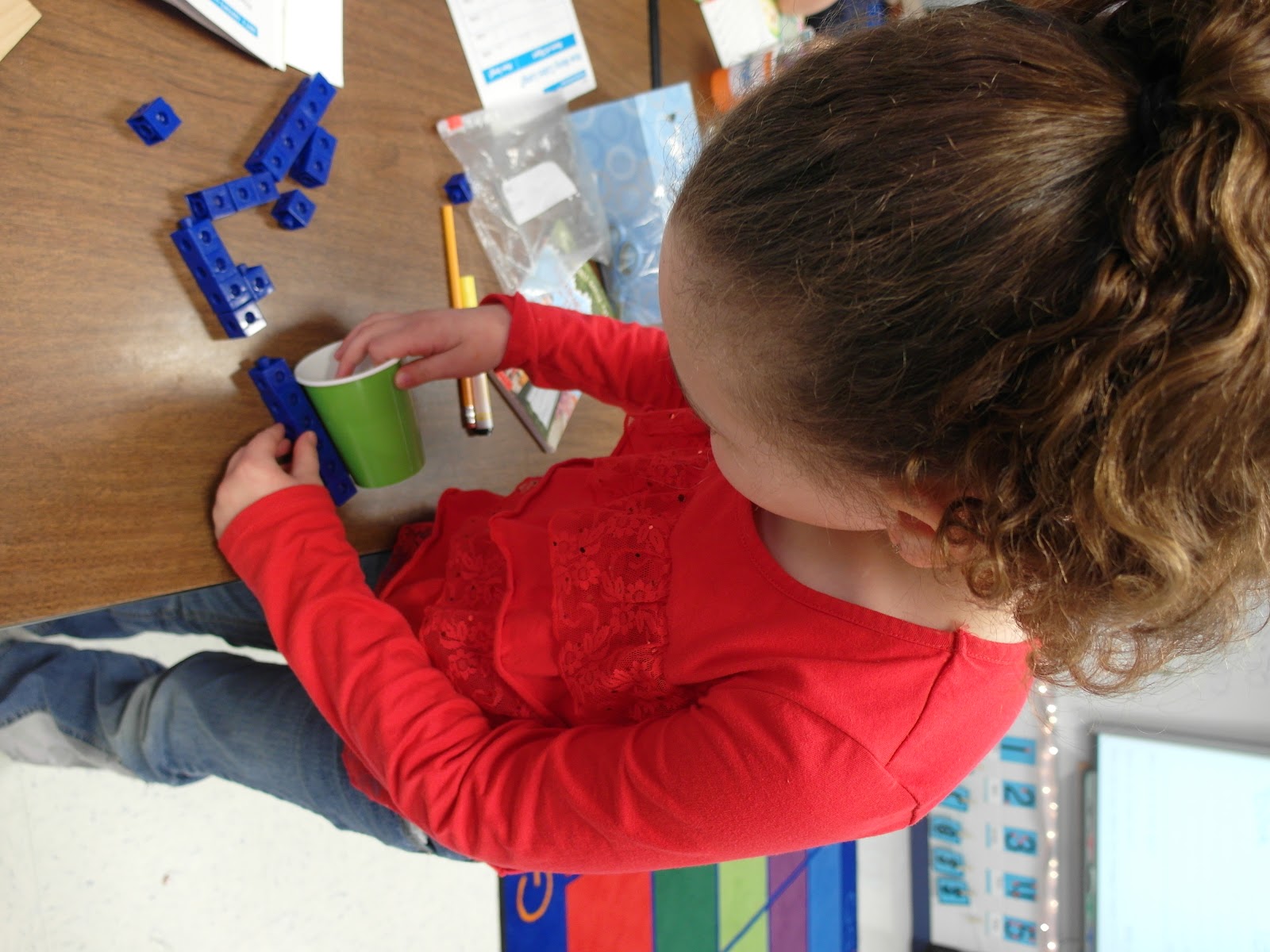


After measuring with smaller units, we moved into measuring longer distances or lengths with bigger units. We measured using baby steps, kids steps, craft sticks, and basketball player steps.


Students have really seemed to enjoy measurement and using the different units!
Our unit test will ask the student to explain why different units give different measurements for the same length.
--Ms. Brandt
Thursday, August 23, 2012
Math Workshop & Investigations
We have a new math curriculum that aligns with the Common Core Standards. It is similar to our Investigation's curriculum that we had last year--only modified a little. :) The first few sessions gives students the opportunity to explore the materials they will be using throughout the school year. I was AMAZED by the creations the students made! They also did very well working together with the others at their group! Needless to say, it has been a very fun, eventful first full week of school! I am very excited for all that lies ahead! :)
--Ms. Brandt
Subscribe to:
Posts (Atom)